
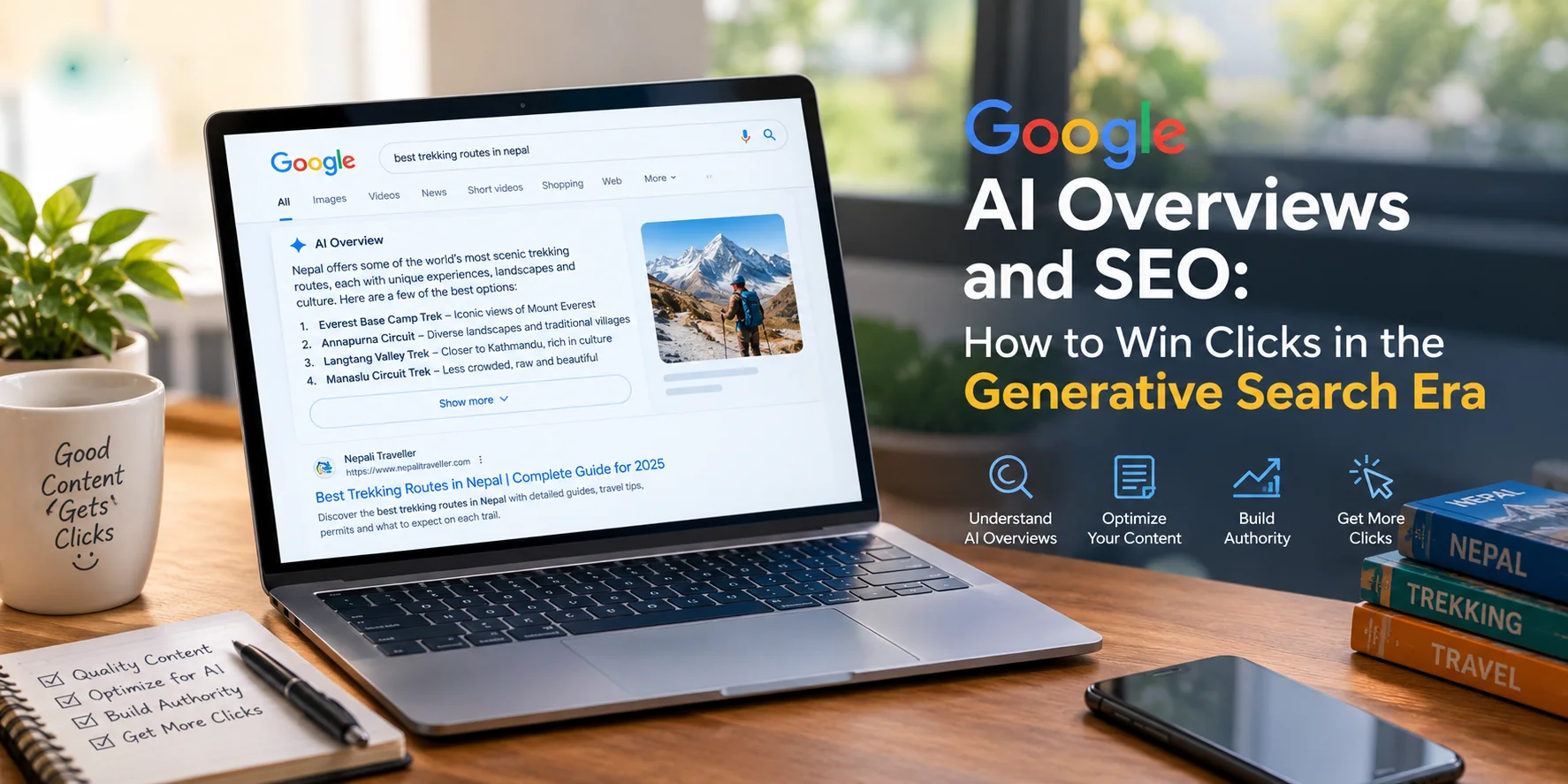
Search engine optimization is no longer just a battle for the traditional “ten blue links.” With Google rolling out and refining AI Overviews (formerly known as Search Generative Experience / SGE), synthesized answers now sit directly at the top of the search engine results page (SERP) for many complex, informational queries.
While some website owners worry that AI summaries will erode their organic traffic, smart marketers recognize a massive shift: AI Overviews don’t eliminate traffic, they redefine who gets it.
Quick Summary
- What Happened: Google’s AI Overviews generate direct answers to multi-layered queries, displaying clickable citation cards alongside synthesized text.
- The Impact: Purely informational queries see lower click-through rates (CTR) on basic definitions, but visitors who click through cited links show significantly higher engagement and purchase intent.
- The Strategy: To get cited, publishers must shift away from cookie-cutter summaries toward information gain, structured semantic formatting, and verifiable first-hand experience (E-E-A-T).
What Are Google AI Overviews?
An AI Overview is a multi-source summary generated by Google’s Gemini models that appears at the top of the search results page. Instead of requiring a user to open three separate articles to research a topic, the AI pulls key points from trusted pages across the web and synthesizes them into a single, cohesive answer.
Crucially, AI Overviews include citation carousels and in-line link icons pointing back to the web pages used to generate each part of the summary.
When Do AI Overviews Appear?
AI Overviews do not trigger for every search. They appear primarily for:
- Complex, informational queries: “How to migrate a WordPress site without losing rankings”
- Comparative research: “Static site generator vs traditional CMS for local business”
- Nuanced, multi-part questions: “Best walking shoes for flat feet with good arch support”
Navigational searches (e.g., “YouTube login”) and simple local or transactional queries trigger them far less frequently.
Why It Matters: The Traffic Shift
- Lower CTR for Commodity Content: If an article merely rehashes a two-sentence definition of “What is a 301 redirect?”, searchers can read the AI Overview and bounce without clicking.
- Higher-Intent Referrals: When a searcher clicks a source card inside an AI Overview, they are rarely looking for basic facts; they are seeking deeper verification, actionable steps, or specialized products.
- Organic Ranking Still Feeds the AI: Studies show that a vast majority of pages cited within AI Overviews already rank in Google’s top organic results. Strong foundational SEO remains the baseline requirement for inclusion.
How to Optimize Content for AI Overviews
To make content the preferred source for AI summaries, structure web pages around these best practices:
1. Optimize for “Information Gain”
Google’s algorithms actively look for unique value. If an article only restates what five competitor sites already say, the AI has no incentive to cite it.
- Include unique case studies, client data, or original surveys.
- Offer specific numbers, real-world examples, or personal observations from subject-matter experts.
- Add fresh commentary or counter-intuitive findings that generic AI drafts cannot replicate.
2. Format with “Inverted Pyramid” Answers
AI crawlers parse text to find clean, direct answers to user questions:
- H2/H3 as Questions: Formulate subheadings as direct search questions (e.g.,
### How long does a 301 redirect take to pass authority?). - Direct Answer First: Provide a concise, clear 1–2 sentence answer immediately below the heading.
- Elaborate Below: Follow the direct answer with detailed explanations, context, or visual tables.
3. Build Topic Clusters and Internal Authority
AI search engines prioritize sites with clear topical depth. Rather than publishing isolated, scattershot blog posts, group related content into clusters:
- Create a comprehensive cornerstone guide.
- Support it with 4–6 tightly related sub-topic articles.
- Link them together with relevant, descriptive anchor text.
4. Implement Robust Schema and Clean Hierarchy
- Use valid Schema markup (
Article,Product,HowTo) to help crawlers understand entities and authors. - Maintain clean heading hierarchy (H1 -> H2 -> H3) without skipping levels.
- Use bulleted lists and Markdown comparison tables for multi-attribute comparisons.
What Site Owners Should Avoid
- Do not panic-delete older content: A dip in click impressions on high-level definitions does not mean an entire site is penalized.
- Avoid generic AI-generated filler: Publishing unedited, mass-produced text without human oversight increases the risk of being filtered out by Google’s helpful content algorithms.
- Do not hide behind vague author bios: Ensure articles feature verified author names, credentials, and links to author profiles to satisfy Experience, Expertise, Authoritativeness, and Trustworthiness (E-E-A-T).
Here is the conclusion and beginner-friendly FAQ section designed to fit naturally right before the metadata block of your post.
Conclusion
Google’s shift toward AI Overviews marks an evolution in search behavior, not the end of organic traffic. While informational queries that require only a quick, one-sentence answer will naturally see fewer clicks, high-value visitors, those looking for nuanced solutions, trusted advice, and authentic experience still seek out full articles.
The formula for long-term SEO success hasn’t vanished; it has sharpened:
- Build deep topical authority rather than chasing disconnected keywords.
- Focus on information gain by sharing original insights, experiments, and first-hand knowledge.
- Format content cleanly so both humans and search engine crawlers can instantly identify your core answers.
Sites that consistently demonstrate authentic expertise and deliver real value beyond a generic AI response won’t just survive this transition they will become the definitive sources Google relies on to answer complex queries.
Frequently Asked Questions (FAQ)
1. Will Google AI Overviews destroy my website traffic?
Not necessarily. While high-level, definitional queries (like “What is a meta tag?”) may see lower click-through rates, detailed and specialized topics still drive strong traffic. Visitors who click on source links inside AI Overviews tend to have higher engagement and clearer intent because they have already moved past basic definitions.
2. Can I block Google from using my content in AI Overviews?
Yes, but with trade-offs. You can use standard Googlebot directives like nosnippet, max-snippet, or the data-nosnippet HTML attribute to restrict what Google previews. However, limiting snippets can also reduce your visibility in traditional search features like featured snippets and rich results.
3. Do I need to rank on page one to be cited in an AI Overview?
In most cases, yes. Data shows that the vast majority of sources cited in AI Overviews are pulled from pages already ranking within the top organic results for that query. Strong core SEO, site speed, clean indexing, backlinks, and keyword relevance remains the foundation for inclusion.
4. How can I track if my website appears in AI Overviews?
Google Search Console currently aggregates AI Overview impressions and clicks into your overall organic Search performance data. To track specific placements, you can monitor your top keywords through modern rank-tracking tools that detect SERP features and record whether your domain is cited in an AI Overview panel.